





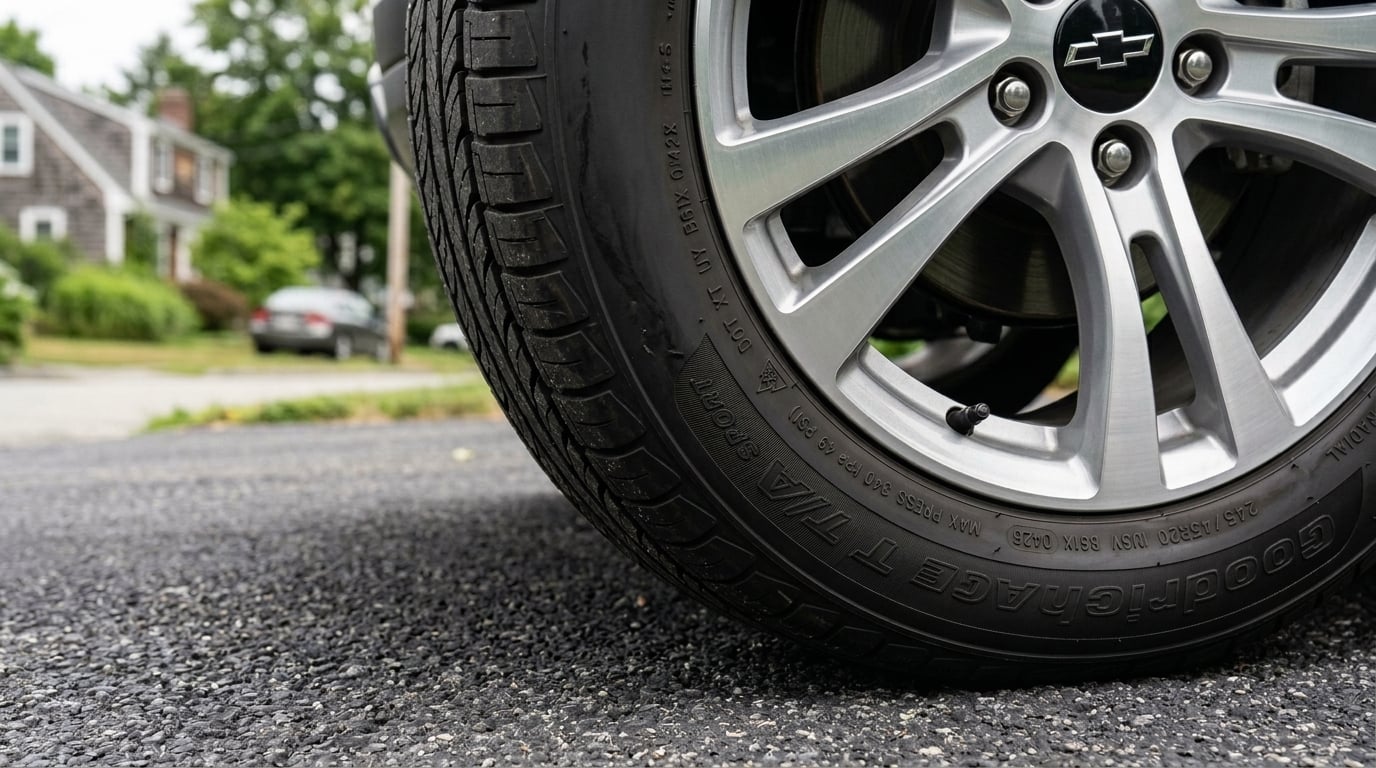
You can find the exact factory tire specifications for a 2026 Chevrolet on the vehicle’s Tire and Loading Information placard located on the driver side B-pillar door jamb, inside the owner’s manual, and directly on the tire sidewall. The placard lists the OEM-approved tire size, recommended cold inflation pressures for front and rear tires, maximum load capacity, and spare tire inflation specs calibrated specifically for your vehicle’s gross axle weight ratings.
Every Chevrolet vehicle engineered for 2026 features a standardized tire code stamped on the sidewall that defines its dimensions and structural limits. Reading a size like P225/65R17 reveals distinct technical parameters:
- P-Metric Classification: The letter P signifies a passenger-car tire design, whereas LT denotes a light-truck build engineered for heavier payload and trailer weights.
- Section Width: The three-digit number specifies the tire’s width in millimeters from sidewall to sidewall when mounted on an OEM rim.
- Aspect Ratio: The two-digit number after the slash represents the sidewall height as a percentage of the section width.
- Internal Construction: The letter R indicates radial construction, where internal ply cords run perpendicular to the direction of travel.
- Wheel Diameter: The final two-digit number defines the wheel rim diameter in inches required for correct fitment.
Following the size designation, the sidewall includes the load index and speed rating—critical figures such as 95H or 102V. The load index maps to the maximum weight capacity each tire safely supports when set to the cold inflation pressure specified on the door jamb. The speed rating letter defines the maximum sustained speed the tire can handle under standardized laboratory tests. Maintaining these exact OEM ratings preserves designed handling dynamics, braking distances, and stability control calibration.
When replacing tires or inspecting wear, drivers can confirm factory specifications by visiting our service center in North Dartmouth or by calling (508) 996-6266 to speak with a factory-trained technician.
Table of Contents
- How Do Load Ratings and Pressures Change for Towing and Heavy-Duty 2026 Chevrolet Truck Configurations?
- What Are the Standard Tire Sizes, Bolt Patterns, and Speed Ratings for the 2026 Chevrolet Silverado 1500?
- How Often Should You Check Tire Pressure and When Should Winter Tires Be Installed in Eastern Massachusetts?
- Should You Get a Wheel Alignment When Replacing Tires on Your 2026 Chevrolet?
- Commonly Asked Questions About 2026 Chevrolet Tire Care and Maintenance
- Schedule Your Chevrolet Tire Care and Inspection
How Do Load Ratings and Pressures Change for Towing and Heavy-Duty 2026 Chevrolet Truck Configurations?
Tire load ratings and cold inflation pressures must increase substantially when 2026 Chevrolet heavy-duty trucks haul maximum payloads or tow heavy trailers to prevent sidewall overheating and maintain vehicle stability. Standard passenger-rated tires carry fixed load capacities at normal street pressures, whereas heavy-duty light-truck tires utilize higher ply ratings—such as Load Range E or Load Range F—that permit higher inflation pressures to support heavy tongue weights and bed loads.
On Chevrolet trucks equipped with optional heavy-duty suspension setups, off-road equipment, or the Max Trailering Package, cold tire pressure requirements differ between unloaded driving and heavy commercial service. When operating a truck under maximum load, rear tire pressures are frequently specified higher than front tire pressures—sometimes requiring up to 65 psi on rear tires compared to lower pressures for normal daily commuting. Increasing pressure under heavy loads reduces sidewall flex, which lowers internal heat buildup and improves tread contact when pulling heavy equipment along the coastal plain around Wareham.
| Configuration / Application | Typical Tire Construction |
Target Rear Pressure Range |
Primary Service Benefit |
|---|---|---|---|
| Standard Daily Driving | P-Metric / Standard Load | 35 psi to 38 psi | Optimizes ride comfort and even tread wear |
| Heavy Bed Payload | Light Truck (Load Range E) | 50 psi to 60 psi |
Supports rear axle weight without sidewall deflection |
|
Maximum Gooseneck / Trailering |
Heavy Duty (Load Range E / F) |
60 psi to 80 psi |
Maintains directional stability and controls trailer sway |
Overloading a tire without adjusting inflation pressure compromises tread contact and strains the internal radial belting. Conversely, running maximum towing pressures on an empty truck crown-wears the center tread and harshness increases across minor road imperfections. Owners should always reference the tire pressure placard on the door jamb for specific gross vehicle weight ratings (GVWR) and adjust pressures using an accurate pressure gauge before hitching a heavy payload.
What Are the Standard Tire Sizes, Bolt Patterns, and Speed Ratings for the 2026 Chevrolet Silverado 1500?
The 2026 Chevrolet Silverado 1500 utilizes several standard factory tire sizes ranging from 17-inch steel wheels on work trucks up to 22-inch aluminum wheels on high-tier trims. Engine choices, trim levels, and regional package selections dictate the factory wheel diameter and tire profile fitted at the assembly plant.
Standard factory tire dimensions for the 2026 Silverado 1500 lineup include:
- 255/70R17 (Standard on WT base configurations)
- 265/70R17 (Standard on Custom and select mid-tier trims)
- 265/65R18 (Standard on LT, RST, and Trail Boss models)
- 275/60R20 (Standard on LTZ and High Country models)
- 275/50R22 (Optional on High Country premium packages)
Across all 2026 Silverado 1500 models, the factory wheel bolt pattern measures 6×139.7mm (also referred to as 6×5.5 inches) with a hub-centric center bore measuring 78 mm. This bolt pattern ensures precise wheel alignment over the axle hub flange, distributing vehicle mass and cornering torque evenly across all six wheel studs. When switching between wheel sizes—such as moving from a 20-inch highway wheel down to an 18-inch wheel for off-road durability—maintaining the overall tire outer diameter ensures the speedometer, odometer, and transmission shift algorithms function correctly without recalibration.
Factory tires for the Silverado 1500 generally carry a speed rating of S (rated for sustained speeds up to 112 mph) or T (rated up to 118 mph), paired with a load index between 112 and 116. These speed and load specs match the truck’s speed-governed top velocity and electronic chassis controls like StabiliTrak. Fitting replacement tires with lower speed ratings or reduced load indices can affect braking distance and traction response during high-load maneuvers.
How Often Should You Check Tire Pressure and When Should Winter Tires Be Installed in Eastern Massachusetts?
Tire pressure on a 2026 Chevrolet should be checked at least once a month when the tires are cold, as ambient air temperature fluctuations directly alter inflation levels. For every 10-degree drop in outside air temperature, tire pressure drops approximately 1 psi. In addition to monthly checks, drivers should verify tire pressures before extended highway trips or whenever carrying heavy cargo.
In Eastern Massachusetts, winter tire installation should occur in mid-November when ambient daily temperatures consistently drop below 45 degrees Fahrenheit. All-season rubber compounds begin to harden at sub-47-degree temperatures, reducing flexibility and wet-road grip. Specialized winter tires utilize micro-silica tread compounds that stay pliable in freezing weather, paired with dense siping patterns that grip snow and slush.
Massachusetts law permits the use of studded winter tires on public roadways only from November 1 through April 30. Vehicle owners driving rural routes near Rochester rely on dedicated winter tread to clear mud, snow, and ice from unpaved agricultural roads during early spring thaws. Winter tires should be removed and stored around early April when ambient daily temperatures climb reliably back above 45 degrees, preventing premature tread wear on warm pavement.
Checking pressure must always be done while the vehicle has been parked for at least three hours or driven less than one mile. Always inflate to the cold tire pressure specification listed on the driver’s door B-pillar rather than the maximum pressure stamped on the tire sidewall, which reflects only the tire’s structural burst limit.
Should You Get a Wheel Alignment When Replacing Tires on Your 2026 Chevrolet?
Getting a four-wheel alignment when installing new tires on your 2026 Chevrolet is highly recommended to protect your tire investment and ensure predictable vehicle handling. Even slight camber, caster, or toe misalignments caused by pothole impacts or worn suspension bushings will cause rapid, uneven tread wear on fresh tires within a few thousand miles.
Key indicators that signal the need for an immediate wheel alignment include:
- Uneven or feathered wear across the inner or outer tread shoulder of old tires.
- The steering wheel sitting off-center when driving straight on a flat road.
- The vehicle pulling or drifting toward one side of the lane when steering wheel pressure is relaxed.
- Unusual vibration or steering column feedback at highway speeds.
A precise wheel alignment sets all four tires parallel to each other and perpendicular to the road surface, matching Chevrolet factory chassis tolerances. Aligning the suspension during tire installation ensures that advanced safety systems—such as Lane Keep Assist and electronic stability control—receive accurate steering angle sensor data. Skipping an alignment during a tire replacement risks premature tire cupping, reduced fuel economy, and shortened tire lifespan.
Commonly Asked Questions About 2026 Chevrolet Tire Care and Maintenance
Q: Where is the tire pressure monitoring system resetting button located on my 2026 Chevrolet?
Most 2026 Chevrolet models monitor tire pressures automatically using internal rim sensors that update the driver information center as you drive. If a low-pressure warning remains illuminated after inflating tires to the door-jamb specification, driving the vehicle above 20 mph for several minutes typically recalibrates the Tire Pressure Monitor System. On select models, sensor learning modes can be accessed directly through the infotainment vehicle status menu or steering wheel controls.
Q: How do I read the age of a tire using the DOT code on the sidewall?
The manufacturing date of any Chevrolet tire is stamped within the DOT serial code located near the wheel rim edge on the sidewall. Look for a four-digit number at the end of the code string. The first two digits represent the week of production (from 01 to 52), while the last two digits represent the year. For example, a code ending in 1225 indicates the tire was manufactured during the 12th week of 2025.
Q: Can I downsize my 20-inch wheels to 18-inch wheels for winter driving on a Silverado?
Yes, downsizing from 20-inch factory wheels to 18-inch wheels is a common practice for winter driving on a 2026 Chevrolet Silverado. The smaller wheel diameter allows for a taller tire sidewall, which provides improved cushion against pothole impacts and superior snow traction. When downsizing, ensure the replacement 18-inch wheel clears the front brake calipers and maintains the factory 6×139.7mm bolt pattern and overall tire outer diameter.
Q: How often should tires be rotated on a 2026 Chevrolet SUV or truck?
Tires should be rotated every 7,500 miles or during every engine oil service, whichever comes first. Regular rotation redistributes front-to-rear tread wear evenly, particularly on front-wheel-drive crossovers where front tires handle steering, braking, and drive torque simultaneously. Following the recommended cross-switch or front-to-back rotation pattern maximizes tread life and maintains balanced wet-weather traction.
Q: What is the difference between all-season and all-weather tires for New England driving?
All-season tires are designed to handle dry roads, wet spring pavement, and mild summer temperatures, but their rubber compound hardens below freezing. All-weather tires feature advanced silica rubber compounds and aggressive tread patterns certified with the Three-Peak Mountain Snowflake (3PMSF) symbol. This rating indicates they meet designated severe snow performance standards while remaining suitable for year-round driving without seasonal changeouts.
Maintaining your vehicle’s tire health keeps your safety systems functioning properly and preserves optimal handling performance. Drivers can easily request complete tire rotations, wheel balances, and tire inspections by scheduling a certified service appointment online with our maintenance department.
Schedule Your Chevrolet Tire Care and Inspection
Proper tire selection, correct inflation pressures, and routine maintenance are essential for maximizing safety, fuel efficiency, and performance in your 2026 Chevrolet. Whether you need an official tread depth evaluation, a precision wheel alignment, or seasonal winter tire changeouts, our factory-trained technicians provide complete support using genuine OEM specifications and specialized diagnostic equipment.
Our state-of-the-art service department maintains a comprehensive inventory of factory-approved tires designed specifically for Chevrolet cars, crossovers, and heavy-duty trucks. We inspect sidewall integrity, check DOT date codes, verify load index ratings, and program tire pressure monitoring sensors to keep your vehicle performing exactly as engineered.
Take action today to protect your vehicle investment and maintain optimal stopping power on regional roads. Get complete tire service by visiting our North Dartmouth location or give our service team a call at (508) 996-6266 to speak directly with a service coordinator.
© 2026 Colonial South Chevrolet. All rights reserved.
Connect with us

