




Blog / New Inventory

2027 Chevrolet Traverse: Family SUV for Three-Row Living

2027 Chevrolet Traverse: Family SUV for Three-Row Living

The 2027 Chevrolet Traverse is the right choice for families who need genuine three-row space, a capable towing rating, and a turbocharged powertrain without stepping into full-size truck territory. Every trim carries 328 hp and 326 lb-ft of torque from a 2.5L turbocharged engine, seats 7, and tows up to 5,000 lbs. The FWD LT and FWD RS return an estimated 22 mpg combined, while all three AWD trims manage 21 mpg combined — a practical balance of performance and efficiency for active families.

Table of Contents

How Well Does the 2027 Chevrolet Traverse Serve Families?

The 2027 Traverse is purpose-built for families who fill three rows regularly and still need cargo room left over. With about 23 cu ft of cargo space behind the third row and about 98 cu ft when all rear seats are folded, it handles the full spectrum of family logistics — from a week's worth of groceries to a complete set of camping gear for a weekend at Allens Pond Wildlife Sanctuary.

The seating configuration follows a 2+2+3 layout across all five trims. Front headroom measures 42.6 in, second-row headroom is 40 in, and the third row provides 38.3 in — generous enough that Edmunds notes the Traverse offers nearly as much headroom and legroom in all three rows as the larger Tahoe, and more than most crossover competitors. Second-row legroom comes in at 41.5 in, and third-row legroom is 32.1 in, which is workable for younger passengers on longer drives.

The standard 7-passenger capacity means a family of five has the flexibility to bring grandparents, carpool the soccer team, or load up gear without renting a second vehicle. A three-zone automatic climate control system keeps everyone comfortable across all rows, with rear passenger controls included. Wireless charging, 4 front USB charging ports, 2 rear USB ports, and 2 third-row USB ports mean every device stays charged on the road.

Families shopping for their next vehicle can browse our current new Traverse inventory to see which trims and configurations are available now at Colonial South Chevrolet.

Design That Complements Natural and Coastal Landscapes

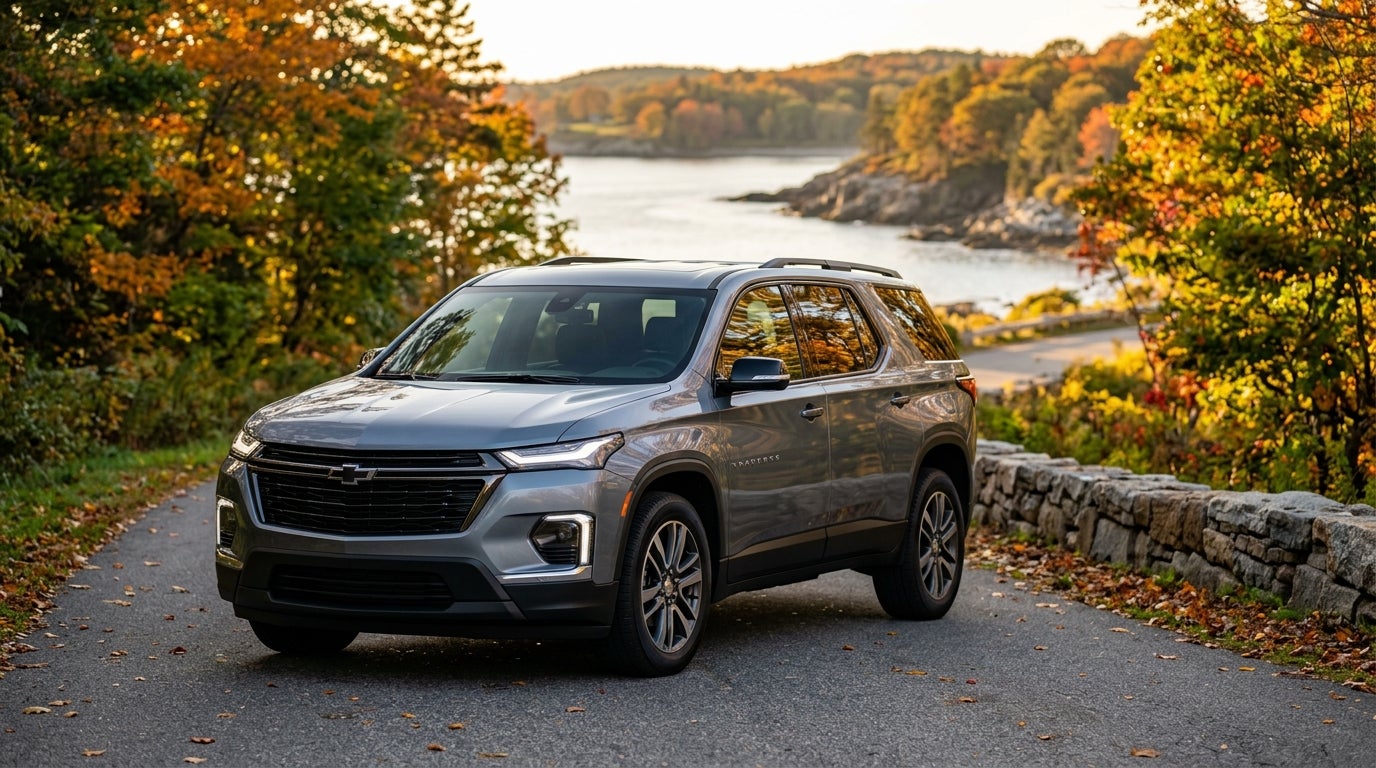
The 2027 Traverse in Dartmouth has a presence that reads well against both the open farmland of rural southeastern Massachusetts and the waterfront scenery of the coast. Its exterior runs 204.5 in in overall length, 79.6 in wide, and 69.6 in tall — proportions that give it a commanding but not oversized stance. The 121 in wheelbase contributes to the stable, planted look that suits an SUV asked to handle everything from school pickup to trailhead parking.

The AWD LT and FWD LT trims carry chrome bright trim around the side windows and a painted front bumper, giving them a traditional, polished appearance. The AWD RS and FWD RS trims swap that chrome for black trim around the side windows, adding a sharper, more contemporary look that pairs well with the standard 22 in alloy wheels on both RS configurations. The AWD Z71 takes a different direction entirely — its exterior signals off-road intent with black trim accents, front tow and recovery hooks, and a raised ride height of 7.8 in of ground clearance compared to 6.8 in on the other trims.

Six exterior color choices have been announced, including Summit White, Mosaic Black Metallic, Radiant Red Tintcoat, Sterling Gray Metallic, Polar White Tricoat, and Trillium Green Metallic. Interior options range from Jet Black Premium Cloth and Jet Black/Gideon Premium Cloth on the LT trims to Jet Black Evotex synthetic leather on the RS and Z71 trims, with a Jet Black with Torch Red Stitching Evotex Ultra option on the RS. A roof spoiler is standard across all trims, and black roof rails come standard as well.

If you're planning to trade in your current vehicle before stepping into a Traverse, you can get an estimate on what your trade-in is worth before you visit.

Power and AWD Performance Tailored for Coastlines and Rural Roads

Every 2027 Chevy Traverse trim in Dartmouth — regardless of whether you choose front-wheel drive or all-wheel drive — is powered by the same 2.5L turbocharged four-cylinder engine producing 328 hp at 5500 rpm and 326 lb-ft of torque at 3500 rpm, paired with an automatic 8-speed transmission. That output is substantial for a family crossover, and MotorTrend notes that the Traverse's steering, brakes, body control, and handling are all better than they need to be for a family hauler.

Feature AWD LT AWD RS AWD Z71 FWD LT FWD RS
Drivetrain All-wheel drive All-wheel drive All-wheel drive Front-wheel drive Front-wheel drive

All five trims share: Engine: 2.5L · Horsepower: 328 hp · Torque: 326 lb-ft · Transmission: automatic 8-speed

The drivetrain choice shapes fuel economy meaningfully. FWD trims gain a highway advantage:

Feature AWD LT AWD RS AWD Z71 FWD LT FWD RS
MPG 20 city / 24 hwy / 21 combined 20 city / 24 hwy / 21 combined 20 city / 24 hwy / 21 combined 20 city / 26 hwy / 22 combined 20 city / 26 hwy / 22 combined

The AWD Z71 is the trim most directly built for mixed terrain. It adds a d e scent control system, a raised ride height, standard all-terrain tires, and front tow/recovery hooks — the right combination for gently rolling farmland roads and the seasonal mud that comes with them. The AWD system on the LT and RS trims is full-time, providing continuous traction distribution without driver input, which is valuable on the coastal wetland roads and marsh-adjacent routes common in the region.

The suspension is independent front strut with coil springs and an independent rear multi-link setup with coil springs across all trims, delivering a composed ride that Car and Driver describes as feeling smaller than the Traverse's actual size once you pick up speed. The 21.7 gal fuel tank gives the FWD trims a calculated range of 477 mi and the AWD trims 456 mi before refueling.

Spacious Interior Comfort for Family Gear and Weekend Adventures

The numbers tell the story clearly: about 23 cu ft of cargo space with all seats in place, expanding to about 98 cu ft with the rear seats folded. That second figure is what matters when a family is packing for a day of boating at the waterfront — fishing gear, life jackets, coolers, and folding chairs all fit without negotiation.

The interior dimensions are consistent across all five trims, since the Traverse rides on a shared platform regardless of drivetrain or trim level.

Measurement Value
Overall length 204.5 in
Overall width 79.6 in
Overall height 69.6 in (70.7 in on AWD Z71)
Wheelbase 121 in
Front headroom 42.6 in
Second-row headroom 40 in
Third-row headroom 38.3 in
Front legroom 44.3 in
Second-row legroom 41.5 in
Third-row legroom 32.1 in
Front shoulder room 62.3 in
Second-row shoulder room 62.2 in
Third-row shoulder room 57.7 in
Cargo (all seats in place) 22.9 cu ft
Cargo (rear seats down) 97.6 cu ft
Loading floor height 30.7 in

The driver's seat is electrically adjustable on all trims, with the AWD LT, FWD LT, and AWD Z71 offering 4-way power adjustment and the AWD RS and FWD RS stepping up to a 6-way power driver's seat with memory, 2-way electric lumbar, and a power-adjustable passenger seat as well. Heated front and rear seats are standard on the RS trims. The second-row seats fold asymmetrically for flexible cargo configurations, and the third-row split bench folds flat to the floor as well. Front and rear center armrests, cup holders at all rows, and a full floor console round out the practical storage picture.

The AWD RS and FWD RS also add ambient interior lighting and alloy door sill protectors as standard equipment, giving the cabin a more polished feel without requiring an upgrade package.

Connected Tech to Navigate Local Routes and Community Events in Rochester and Beyond

A 17.7 in central touchscreen is standard across all five trims — one of the largest infotainment displays in the class, and a meaningful advantage for navigating unfamiliar routes or managing audio on a long family drive. Paired with an 11 in digital instrument cluster, the dual-screen setup gives the cabin a modern, information-rich environment. The navigation system includes satellite view, internet-connected traffic data, and map updates — both covered for 96 months of subscription.

Wireless Apple CarPlay and wireless Android Auto are standard on all trims, meaning phones connect without cables. Google built-in apps and voice assistant support are also included. Bluetooth is standard, and a wireless charging pad is fitted across the lineup. The embedded Wi-Fi hotspot uses an in-vehicle SIM card and includes a 3-month data subscription at purchase, with the option to extend to a 3-year OnStar One subscription that covers telematics, remote services, and connected data.

OnStar telematics come standard on all trims with a 96-month subscription covering remote lock/unlock, vehicle start, find-my-car, send-destination-to-car, and vehicle diagnostics. Advanced automatic collision notification is included as well. Over-the-air software updates allow Chevrolet to push improvements to the vehicle without requiring a dealership visit.

The AWD LT and AWD Z71 trims offer the optional Enhance Driving Package, which adds a 12-speaker Bose® audio system with subwoofer and upgrades the cruise control to Super Cruise — a hands-free driver assistance system that operates on mapped roads. The AWD RS and FWD RS trims include the 12-speaker Bose® system and Super Cruise as standard equipment, making them the most tech-forward configurations in the lineup without any additional packages required. Traffic sign recognition and a digital rear-view mirror are also standard on the RS trims.

Steering wheel audio controls, satellite radio with a 3-month trial, and internet radio are standard across all five trims.

Safety Systems Designed for Rural Roads and Suburban Streets

Seven airbags are standard across every 2027 Traverse trim — front driver and passenger airbags, front side airbags, side curtain airbags covering all three rows, and front hip airbags. That coverage extends protection to every seat position in the vehicle, which matters when the third row is regularly occupied by younger passengers.

The active safety suite is equally comprehensive. Forward Collision Alert with automatic emergency braking activates at speeds as low as 5 mph and operates at both low and highway speeds. Intersection Automatic Emergency Braking uses a radar-and-camera system to detect cross-traffic threats at intersections. Rear Cross Traffic Braking monitors the area behind the vehicle when reversing. Lane Keep Assist (LKA) applies gentle steering correction when the vehicle begins to drift from its lane. Side Blind Zone Alert monitors the blind spot zones on both sides and alerts the driver without requiring a turn signal input.

ABS, brake assist, electronic traction control, stability control, hill holder, and an electronic parking brake with auto-hold are all standard. The Traverse also includes a tire pressure monitoring system that displays individual tire pressures, an accident data recorder, and emergency call capability through OnStar.

The AWD RS, FWD RS, and the optional Driver Confidence Package on the AWD LT, FWD LT, and AWD Z71 add a 360-degree HD Surround Vision camera system with front, side, and rear cameras, a digital rear-view mirror, rear seat monitoring camera, traffic sign recognition, and a full automatic park-assist system that can handle perpendicular and parallel parking without driver steering input. The Enhance Driving Package on the LT and Z71 trims adds Driver Attention Assist, which monitors driver alertness and intervenes when necessary, along with full Super Cruise Level 2 automation capability.

LATCH child seat anchors are standard, and all three rows include 3-point seat belts at every seating position, including the center of the third row.

Affordable Family SUV Pricing Across AWD LT, AWD RS, AWD Z71, FWD LT, and FWD RS Trims

The 2027 Traverse has been announced with five distinct trim configurations that ladder up in features and capability, giving buyers a clear path from practical entry-level value to sport-focused or off-road-capable configurations.

Trim Drivetrain MSRP MSRP incl. Destination
FWD LT Front-wheel drive $40,800 $42,795
AWD LT All-wheel drive $42,800 $44,795
AWD Z71 All-wheel drive $49,100 $51,095
FWD RS Front-wheel drive $55,800 $57,795
AWD RS All-wheel drive $57,800 $59,795

The FWD LT at $40,800 is the entry point, offering the full powertrain, 7-passenger seating, the 17.7 in touchscreen, adaptive cruise control, Rear Park Assist, heated front seats, and the complete active safety suite. The AWD LT at $42,800 adds all-wheel drive for $2,000 more — a reasonable premium for families who regularly encounter variable terrain or want the confidence of AWD for year-round driving.

The AWD Z71 at $49,100 is the capability-focused choice, adding all-terrain tires, a raised ride height, descent control, and front recovery hooks over the AWD LT. The FWD RS at $55,800 and AWD RS at $57,800 are the premium sport trims, with the RS bringing standard Bose® audio, Super Cruise, HD Surround Vision, memory seating, heated front and rear seats, and the full tech package without requiring any additional options.

Destination charges of $1,995 apply to all trims. Buyers who prefer a pre-owned option can also browse our pre-owned SUV inventory for additional choices at Colonial South Chevrolet.

Local Service Support and Warranty Coverage

The 2027 Chevy Traverse is backed by a warranty package that gives owners meaningful protection across multiple years of ownership. The bumper-to-bumper coverage runs 3 years / 36,000 miles, while the powertrain warranty extends to 5 years / 60,000 miles — covering the engine, transmission, and drivetrain components that matter most for long-term reliability. Anti-corrosion coverage runs 6 years / 100,000 miles, paint coverage is 3 years / 36,000 miles, and Chevrolet roadside assistance matches the powertrain term at 5 years / 60,000 miles. A maintenance plan covers 2 years / 24,000 miles of scheduled service.

For Traverse owners in the area, Colonial South Chevrolet at 361 State Rd Rte 6, North Dartmouth, MA 02747 is the local resource for keeping your vehicle in factory condition. The service team is trained specifically on Chevrolet vehicles and uses genuine parts for all repairs and maintenance. When something comes up between scheduled visits, Chevrolet roadside assistance is available for the full 5-year / 60,000-mile term of ownership.

You can book your next service appointment online at any time, and it's worth checking our current service and parts specials before your visit to see what savings are available.

Awards and Expert Recognition Highlighting the 2027 Chevrolet Traverse's Strengths

The 2027 Traverse has not yet accumulated formal model-year awards at this stage of its release cycle, as it has been officially unveiled but not yet broadly on sale. That said, the expert community has consistently praised the Traverse platform on which this generation builds.

Edmunds notes that the Traverse packs a spacious cabin beneath its bold exterior, with nearly as much headroom and legroom in all three rows as the full-size Tahoe — and more interior room than most crossover competitors. That is a meaningful benchmark for a vehicle that positions itself between the Equinox and the Tahoe in Chevrolet's lineup.

MotorTrend highlights that the Traverse's steering, brakes, body control, and handling are all better than they need to be for a family hauler — a point that distinguishes it from rivals like the Ford Explorer, Honda Pilot, Hyundai Palisade, Kia Telluride, and Toyota Grand Highlander that prioritize ride compliance over dynamic feel. Car and Driver adds that the Traverse feels smaller than its dimensions suggest once you're underway — a quality that makes it easier to manage in tighter parking situations and on narrower rural roads while still delivering the interior volume families need.

These assessments reflect a vehicle that competes seriously across the full midsize three-row crossover segment.

Your Questions About AWD, Towing, and Family Seating Answered

Q: Does the 2027 Traverse AWD system work automatically, or does the driver need to engage it?

The all-wheel drive on the AWD LT, AWD RS, and AWD Z71 trims is a full-time system that operates continuously without driver input. The vehicle monitors traction conditions and distributes power between the front and rear axles automatically. The AWD Z71 additionally includes a descent control system for managing speed on steep downhill grades — a useful feature for uneven terrain. The FWD LT and FWD RS use front-wheel drive exclusively, which is a practical choice for buyers whose driving is primarily on paved roads.

Q: What is the maximum towing capacity, and is it enough to haul a small boat?

All five 2027 Traverse trims are rated to tow up to 5,000 lbs when properly equipped. A typical small trailerable sailboat or fishing boat with trailer falls well within that rating. The Traverse includes Hitch Guidance with Hitch View as standard equipment across all trims, which uses the rear camera system to display a guidance overlay that helps align the hitch with a trailer ball — a practical feature for anyone backing a boat trailer down a ramp for the first time.

Q: Can the third row comfortably seat adults, or is it best for children?

The third row offers 38.3 in of headroom, 32.1 in of legroom, and 57.7 in of shoulder room. Those dimensions are workable for shorter adults on shorter trips but are most comfortable for children and teenagers on longer drives. All three rows include 3-point seat belts at every position, including the center of the third row.

Q: Which trim is the best value for a family that wants AWD and good technology?

The AWD LT at $42,800 MSRP covers the core needs — full-time AWD, 7-passenger seating, adaptive cruise control, heated front seats, and the 17.7 in touchscreen — and the optional Driver Confidence Package and Enhance Driving Package add the 360-degree camera and Super Cruise if desired. The AWD RS at $57,800 bundles all of that technology as standard, making it the most complete out-of-the-box package for buyers who want every feature without selecting individual options.

To see current availability or arrange a test drive, stop by Colonial South Chevrolet at 361 State Rd Rte 6, North Dartmouth, MA 02747 or give our team (508) 996-6266 to discuss which trim fits your family's needs.


© 2026 Colonial South Chevrolet. All rights reserved.
Posted in:

Recommended Posts

What Fluid Maintenance Does a 2026 Chevrolet Require

What Fluid Maintenance Does a 2026 Chevrolet Require?

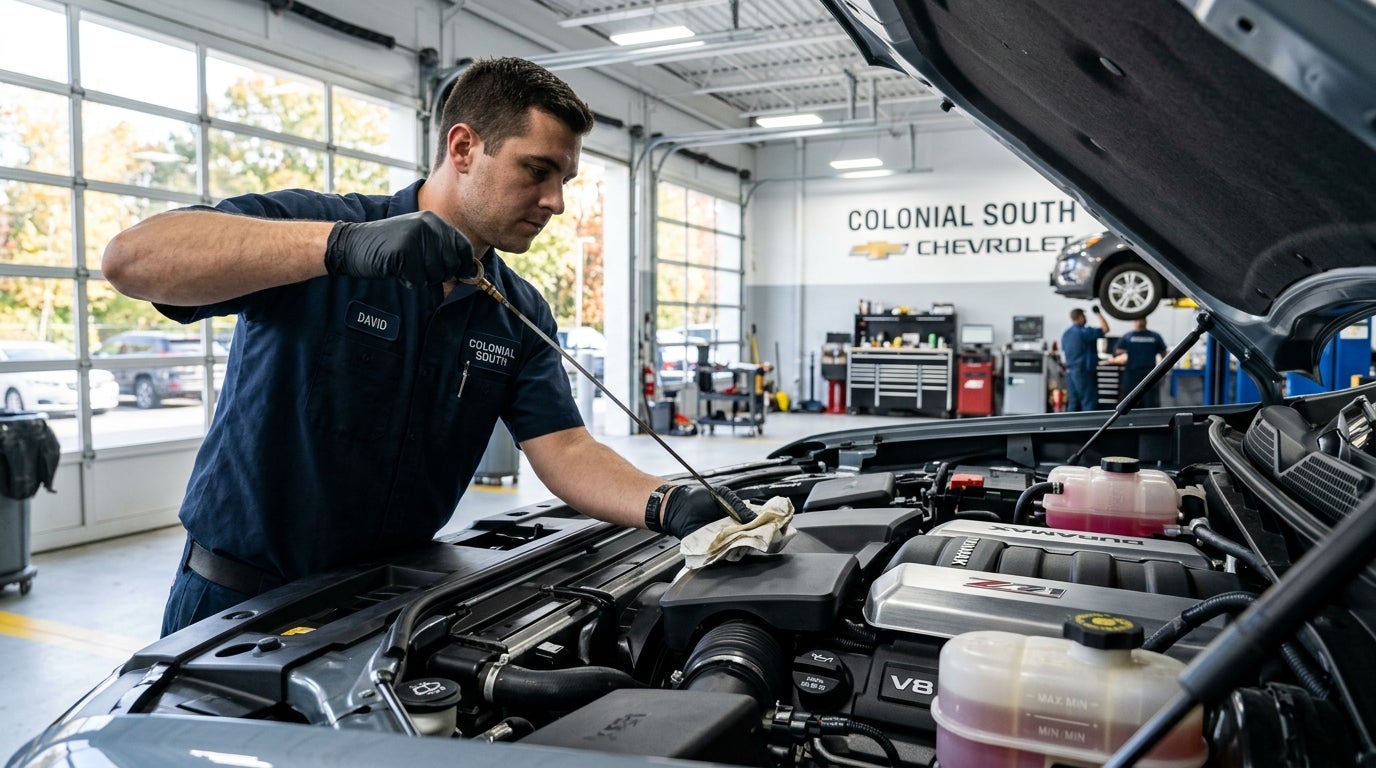
A 2026 Chevrolet requires six primary operational fluids: engine oil ( dexos certified), Dex-Cool engine coolant, DEXRON-VI or DEXRON ULV automatic transmission fluid, DOT 3 or DOT 4 brake fluid, hydraulic power steering fluid (on select equipped models), and freeze-resistant windshield washer fluid. Comprehensive fluid maintenance involves monitoring fluid levels, inspecting for thermal or chemical degradation, topping off depleted reservoirs, and performing full system flushes according to factory-specified maintenance schedules. Modern vehicles monitor routine service needs through automated onboard systems such as the Engine Oil Life System. Rather than relying strictly on fixed mileage intervals, this system calculates oil breakdown based on engine revolutions, operating temperatures, and driving patterns. However, secondary fluids like brake fluid, coolant, and transmission fluid still require routine manual inspections and periodic service to maintain hydraulic pressure, prevent mechanical wear, and guard against internal corrosion. Environmental conditions across New England directly influence how rapidly vehicle fluids degrade. Sub-zero winter temperatures, frequent stop-and-go driving, short trips that prevent engines from reaching full operating temperature, and exposure to corrosive road salt all contribute to severe operating conditions. In agricultural and rural settings around Rochester, unpaved back roads and dusty farm routes create fine particulate buildup that can contaminate engine oil and air filtration systems faster than standard highway driving. Under these severe service guidelines, fluid exchange intervals must be accelerated to protect internal engine and drivetrain components. Maintaining correct fluid levels and scheduled flushes protects your vehicle warranty and maximizes long-term reliability. Vehicle owners can visit our North Dartmouth service center for a complete fluid health check or speak with our certified technical team directly by giving us a quick call at (508) 996-6266. Table of Contents What Types of Fluids Does a 2026 Chevrolet Vehicle Require for Routine Maintenance? What Color Is Chevrolet Dex-Cool Coolant and How Often Should It Be Flushed? What Brake Fluid Specification Does Chevrolet Use and When Should It Be Serviced? How Much Does a Chevrolet Transmission Fluid Flush Cost on Average? Should Chevrolet Fluid Top-Ups and Flushes Be Done at a Dealer or an Independent Shop? Common Questions About Chevrolet Fluid Top-Ups and Flushes What Types of Fluids Does a 2026 Chevrolet Vehicle Require for Routine Maintenance? Routine maintenance for a 2026 Chevrolet relies on factory-approved fluid formulations specifically engineered to withstand precise thermal and mechanical thresholds. General Motors mandates strict fluid standards, including dexos1 Full Synthetic motor oil, Dex-Cool extended-life coolant, and DEXRON automatic transmission fluid, to protect close-tolerance engine and transmission assemblies. Every fluid serves a specialized functional role within the vehicle: Engine Oil: Lubricates moving internal parts, reduces friction, and carries heat away from the engine block. Modern gasoline engines require full synthetic oils meeting the dexos1 Gen 3 standard, while diesel variants require dexosD formulations. Engine Coolant: Manages engine operating temperatures and protects internal metal passages from rust and cavitation. Chevrolet uses silicate-free Dex-Cool organic acid technology coolant. Transmission Fluid: Acts as a hydraulic fluid to power gear shifts, cool planetary gear sets, and lubricate internal clutches. Modern multi-speed transmissions utilize synthetic DEXRON-VI or ultra-low viscosity DEXRON ULV. Brake Fluid: Transfers physical pedal pressure into hydraulic force to activate brake calipers and wheel cylinders. Vehicles use heavy-duty DOT 3 or DOT 4 specifications depending on trim and braking system design. Power Steering Fluid: Provides hydraulic assistance on models fitted with hydraulic steering pumps. Many late-model vehicles use electric power steering ( EPS), which eliminates hydraulic steering fluid entirely. Windshield Washer Fluid: Clears road grime, salt spray, and debris from the windshield. Winter formulations must contain freeze-inhibiting agents capable of remaining liquid down to -20°F. Our technicians note that checking engine oil on level ground after the engine has been switched off for several minutes allows the oil to drain back into the pan, providing the most accurate dipstick reading. Neglecting fluid levels or utilizing non-compliant formulations can result in accelerated component wear, reduced fuel efficiency, and internal mechanical damage. What Color Is Chevrolet Dex-Cool Coolant and How Often Should It Be Flushed? Chevrolet Dex-Cool coolant is bright orange in color, distinguishing it from conventional green ethylene glycol coolants. Under normal operating conditions, General Motors recommends flushing and replacing Dex-Cool every 5 years / 150,000 miles, whichever comes first. Mixing traditional green coolant with orange Dex-Cool is extremely harmful to the cooling system. The chemical interaction between conventional silicates and organic acid technology causes the fluid to gel, creating thick blockages inside radiator cores, heater cores, and engine water jackets. This gelling starves the engine of proper coolant flow, leading to rapid overheating, blown head gaskets, and cracked engine blocks. Severe driving conditions require more frequent cooling system inspections and potential fluid exchanges. Commuters and outdoor enthusiasts towing boat trailers near coastal launching ramps in Wareham subject their engines to sustained high loads under humid, salty ambient conditions. Heavy trailering, prolonged idling, and stop-and-go traffic increase thermal stress, causing anti-corrosion additives in the coolant to break down faster. Routine coolant flushes remove accumulated scale, neutralise acid buildup, and replace depleted corrosion inhibitors. A complete flush ensures the water pump, thermostat, and radiator remain clear of obstructions, preserving optimal operating temperatures year-round. What Brake Fluid Specification Does Chevrolet Use and When Should It Be Serviced? Chevrolet vehicles use DOT 3 or DOT 4 heavy-duty brake fluid, depending on the model, engine package, and performance braking options. GM guidelines recommend replacing brake fluid every 2 years / 45,000 miles or whenever testing reveals elevated moisture content. Brake fluid is naturally hygroscopic, meaning it continually absorbs moisture from the surrounding air through microscopic pores in brake hoses and reservoir seals. As water accumulates in the hydraulic system, it lowers the boiling point of the fluid. Under heavy braking, the heat generated by the pads and rotors can cause contaminated fluid to boil, creating vapor pockets that result in a spongy brake pedal, increased stopping distances, or total loss of hydraulic braking pressure. Moisture buildup also causes internal corrosion within expensive braking components, including ABS hydraulic control modules, master cylinders, and brake calipers. Rather than simply adding fresh fluid when the reservoir level drops, technicians must inspect the system for pad wear or hydraulic leaks. Owners can maintain braking safety by scheduling a routine service appointment for a complete system test and fluid exchange. How Much Does a Chevrolet Transmission Fluid Flush Cost on Average? A Chevrolet transmission fluid flush costs between $180 and $350 on average, depending on fluid capacity, filter design, and specific transmission architecture. This service covers draining old fluid, flushing internal passages and torque converters, installing fresh synthetic DEXRON fluid, replacing pan gaskets or internal filters where applicable, and resetting transmission adaptive software. Several technical factors influence the total cost of a transmission fluid exchange: Cost Factor Operational Impact Technical Details -- -- -- Fluid Type & Volume Multi-speed automatics require 8 to 12 quarts of full synthetic fluid. Uses licensed DEXRON-VI or DEXRON ULV formulations [2, 3]. Filter & Gasket Design Pan removal requires fresh seals and internal filter replacements. Sealed units utilize internal strainers or drop-pan filter kits [3]. Labor & Fluid Leveling Specialized scan tools verify fluid level at precise operating temperatures. Requires fluid temperature monitoring between 160°F and 200°F [2]. Service Procedure Simple drain-and-fill services cost less than full machine exchanges. Fluid exchanges replace 100% of contaminated fluid in lines and cooler [3]. Transmissions are complex, high-pressure hydraulic systems that rely on clean fluid to cool clutch packs and enable crisp gear engagement. Operating with burnt or oxidized fluid leads to harsh shifting, delayed engagement, slipping clutches, and premature transmission failure. Performing scheduled fluid flushes prevents expensive mechanical overhauls and keeps power delivery smooth. Should Chevrolet Fluid Top-Ups and Flushes Be Done at a Dealer or an Independent Shop? Having fluid services performed at an authorized Chevrolet dealership ensures your vehicle receives factory-approved ACDelco and dexos formulations applied by factory-trained technicians. Dealership service departments utilize specialized diagnostic equipment, such as GM GDS2 scan tools, to perform precise fluid level checks and computer adaptations that independent shops may lack. Independent repair shops often offer convenience and competitive labor rates, but they frequently use generic, multi-vehicle fluids. Using non-compliant fluid in modern Chevrolet transmissions, engines, or cooling systems can void manufacturer warranty coverage on affected components if a failure occurs. GM engine warranties strictly require oils that display the official dexos licensing seal on the container. Dealership service visits also ensure that all completed maintenance is logged into GM’s centralized vehicle service history database. This documented service history supports factory warranty claims, preserves resale value, and integrates directly with pre-paid maintenance programs and owner rewards structures. Common Questions About Chevrolet Fluid Top-Ups and Flushes Q: Does Chevrolet offer pre-paid maintenance plans that cover fluid flushes? Yes, Chevrolet offers Pre-Paid Maintenance and Pre-Paid Maintenance Plus plans that cover scheduled factory services, including oil changes, fluid flushes, and filter replacements. These plans allow owners to lock in routine maintenance costs in advance using genuine GM parts and certified service standards. Q: How can I confirm an independent shop uses GM-compliant fluid? Request an itemized written estimate prior to service that explicitly details the exact fluid specification, such as dexos1 Gen 3, DEXRON-VI, or Dex-Cool. Verify that the technician uses unopened, factory-licensed containers displaying official GM approval symbols rather than bulk universal fluids. Q: What fluid brands are officially approved by General Motors for Chevrolet maintenance? General Motors officially approves ACDelco fluids and specific Mobil 1 synthetic formulations that carry official dexos, DEXRON, or Dex-Cool licensing. These products are engineered and tested specifically to meet GM material standards and seal compatibility requirements. Q: Why does my modern Chevrolet vehicle not have a transmission fluid dipstick? Many modern Chevrolet automatic transmissions use sealed cases to prevent external dirt and moisture contamination. Fluid levels in these units must be verified by a technician using a level plug on the side of the transmission casing while monitoring live fluid temperature data with a diagnostic scan tool. To keep your vehicle operating at peak efficiency, trust your maintenance needs to certified technicians who know your powertrain best. Stop by our North Dartmouth location for a fluid inspection, or give our service team a call at (508) 996-6266 to schedule your next fluid exchange today. © 2026 Colonial South Chevrolet. All rights reserved.
What Is Included in 2026 Chevrolet Brake Service

What Is Included in 2026 Chevrolet Brake Service?

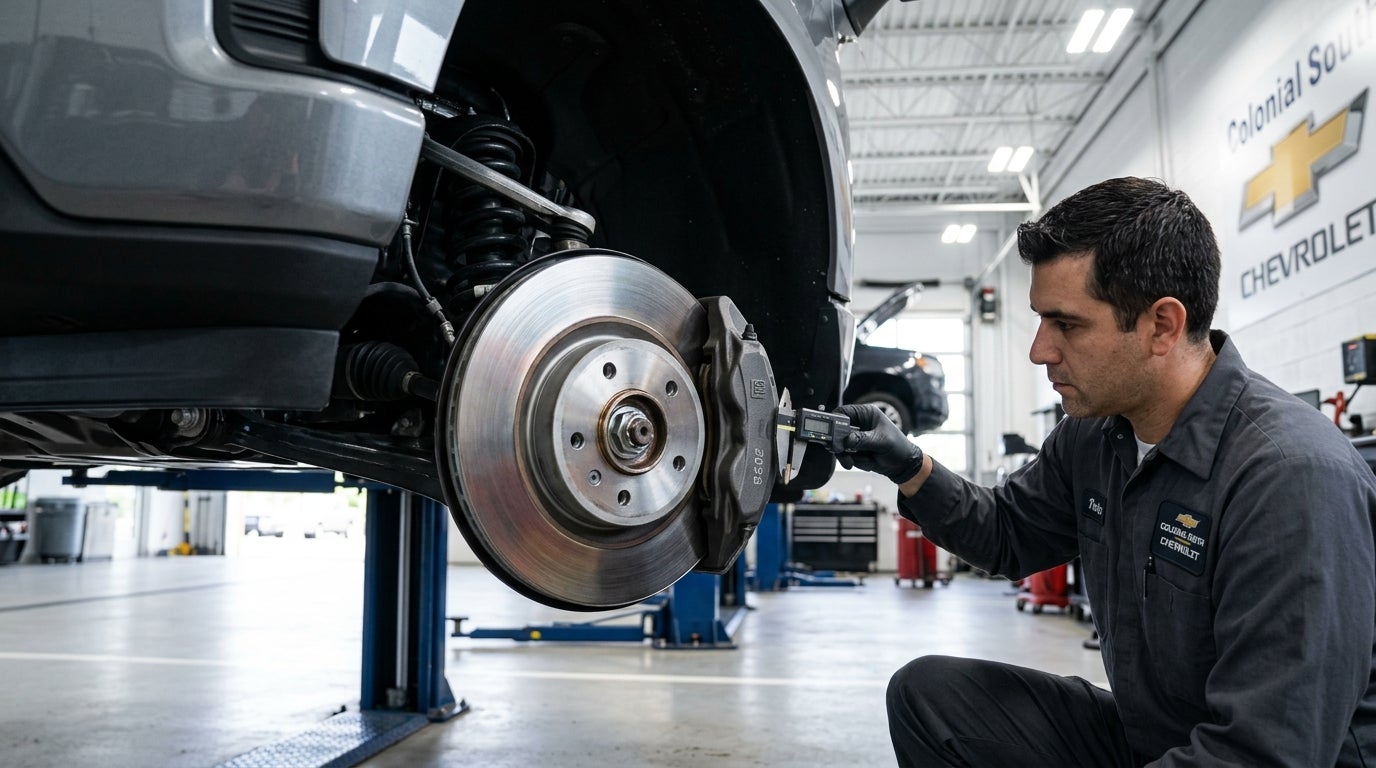
A complete 2026 Chevrolet brake service includes a multi-point physical inspection of the front and rear disc brake pads, Ferritic Nitro-Carburizing rotors, hydraulic calipers, brake lines, and wheel cylinders. Technicians measure pad thickness, evaluate rotor surface condition for thermal scoring or warping, inspect hydraulic hoses for cracks or leaks, test brake fluid for moisture contamination, check wheel bearings and grease seals, and adjust the parking brake assembly. Comprehensive maintenance goes beyond swapping out friction material. When a vehicle enters the bay, factory-trained technicians systematically evaluate every mechanical and hydraulic component in the stopping system. This includes removing the wheels to inspect the inner and outer friction pads for uneven wear patterns, which can signal sticking caliper guide pins or uneven piston pressure. Technicians measure pad friction material using digital calipers to ensure remaining lining exceeds minimum safety thresholds. The hydraulic architecture receives equal scrutiny. Inspecting rigid brake lines for surface rust, punctures, or abrasion from road debris prevents unexpected loss of hydraulic pressure. Flexible rubber brake hoses are flexed and checked for micro-cracks, dry rot, or swelling. Because brake fluid naturally absorbs atmospheric moisture over time, technicians test fluid boiling points and chemical purity to protect against internal corrosion of the master cylinder and anti-lock braking system valves. At our facility located at 361 State Rd Rte 6, North Dartmouth, MA 02747, our service team performs every inspection step according to factory specifications. Drivers can schedule an evaluation or contact our service advisors directly at (508) 996-6266 to review specific vehicle maintenance requirements. Table of Contents What Type of Brake Rotors Are Used on Modern Chevrolet Vehicles? What Are the Main Signs That a Chevrolet Vehicle Needs Brake Service? How Often Should Chevrolet Brakes Be Inspected by a Certified Technician? How Much Does It Cost to Replace Chevrolet Brake Pads Alone? What Are the Advantages of Using Genuine GM Brake Parts Over Aftermarket Alternatives? Frequently Asked Questions About Chevrolet Brake Service Where Can I Get Certified Chevrolet Brake Service in Bristol County? What Type of Brake Rotors Are Used on Modern Chevrolet Vehicles? Modern Chevrolet vehicles utilize Ferritic Nitro-Carburizing ( FNC) rotors, commercially branded as FNC Duralife rotors, which feature a thermochemical surface treatment that hardens the outer layer of the iron disc and protects against rust and premature corrosion. This specialized manufacturing process creates a durable iron-nitride boundary layer across the rotor face and inner cooling vanes. Traditional cast-iron rotors oxidize quickly when exposed to rain, road humidity, or standing water, developing a layer of surface rust that degrades pad friction and causes pedal pulsation. The FNC process alters the molecular structure of the rotor's outer surface by diffusing nitrogen and carbon into the ferrous metal at elevated temperatures. This chemical modification increases surface hardness, reduces mechanical wear, and eliminates corrosion-induced rotor thinning. Key benefits of FNC Duralife technology include: Extended rotor lifespan, often lasting up to double the operational mileage of traditional untreated cast-iron rotors. Resistance to surface rust formation, keeping wheel wells clean and preventing pad adhesion after standing idle in damp weather. Elimination of rust-related brake shudder and steering wheel vibration caused by uneven rotor face pitting. Optimized friction interface when paired with GM Genuine Parts ceramic or semi-metallic brake pad compounds. Engineering FNC rotors directly into modern Chevrolet crossovers, trucks, and sedans ensures consistent stopping distances throughout the lifecycle of the braking system. Because the protective layer is integral to the metal surface, it maintains structural integrity under normal commuting conditions and severe duty cycles alike. What Are the Main Signs That a Chevrolet Vehicle Needs Brake Service? The primary warning signs that a Chevrolet requires brake service include high-pitched squealing or harsh metal-on-metal grinding during deceleration, a soft or spongy brake pedal feel, steering wheel vibration when applying the brakes, extended stopping distances, or an illuminated dashboard brake warning light. Recognizing these symptoms early prevents minor wear from escalating into major system component failures. Audible noises provide the most immediate indication of pad depletion. Original equipment brake pads feature integrated steel mechanical wear indicators. When pad friction material wears down to approximately 2 millimeters, this metal tab contacts the spinning rotor, producing a high-pitched squeal designed to alert the driver. Ignoring this warning allows the pad backing plate to grind directly against the rotor face, destroying the surface finish and drastically reducing stopping force. Hydraulic and mechanical symptoms present distinct diagnostic clues: Spongy or sinking pedal: Caused by air bubbles in the hydraulic lines, low fluid levels, or fluid moisture contamination that lowers the boiling point under heat. Steering wheel shimmy or pedal pulsation: Indicates thickness variation or lateral runout across the rotor face. Vehicle pulling to one side: Points to a seized caliper piston, binding slide pin, or contaminated pad surface on one wheel position. Illuminated warning light: Signals low hydraulic fluid in the reservoir, an anti-lock braking system fault, or an active parking brake engagement issue. Our technicians frequently observe that drivers notice a faint squeak during light braking weeks before hardware contact causes severe rotor damage. Addressing these initial signs promptly keeps routine service simple and cost-effective. Vehicle owners can easily schedule a service appointment online to have our certified team diagnose any unusual stopping behavior. How Often Should Chevrolet Brakes Be Inspected by a Certified Technician? Chevrolet recommends a comprehensive brake system inspection every 7,500 miles or during every routine oil change service interval, whichever comes first. Aligning brake checks with engine oil management ensures components are inspected at least twice a year under average driving conditions. Operating environments heavily influence how rapidly friction materials and hardware degrade. Stop-and-go commuting, frequent heavy payload hauling, mountain driving, and towing accelerate pad wear. Environmental factors like road salt and mud also impact mechanical function. Seasonal salt exposure presents specific challenges for vehicles operating across New England. State agencies treat highways heavily with liquid brine and rock salt during winter months. This corrosive compound settles into brake calipers, slide pins, and rotor cooling vanes. Without periodic cleaning and lubrication, salt buildup causes slide pins to seize, forcing pads to drag against the rotor and wear down prematurely. Driving on rural dirt roads around Rochester introduces ambient dust, sand, and fine gravel into the brake assembly, where debris can lodge between the pad and rotor face to create scoring grooves. Regular 7,500-mile inspections allow technicians to clear trapped grit, lubricate floating pins, and verify that rubber dust boots remain sealed against winter salt intrusion. How Much Does It Cost to Replace Chevrolet Brake Pads Alone? Replacing Chevrolet brake pads alone typically costs between $150 and $300 per axle for parts and professional certified labor. Actual service pricing varies based on vehicle classification, friction material composition, and hardware configurations. Compact crossovers like the Trax or Equinox utilize smaller pad assemblies that fall near the lower end of the cost spectrum. Full-size trucks and heavy-duty SUVs, such as the Silverado or Tahoe, require larger, heavy-duty friction pads engineered for higher thermal loads, moving pad replacement costs toward the higher end of the range. Choosing between standard ceramic formulations and heavy-duty semi-metallic compounds designed for trailering also influences parts pricing. Replacing friction pads before they wear down to the steel backing plate saves hundreds of dollars by preserving the underlying FNC Duralife rotors. Service costs include: Removal of old friction material and installation of axle-matched GM Genuine Parts brake pads. Cleaning and high-temperature lubrication of caliper slide pins, abutment clips, and guide rails. Inspection of caliper boots, piston seals, and hydraulic connections. Safety road-test verification to bed in new pad friction material properly. Replacing brake pads in complete axle sets ensures equal friction coefficient across both left and right wheels, maintaining straight, predictable stopping power under hard deceleration. What Are the Advantages of Using Genuine GM Brake Parts Over Aftermarket Alternatives? GM Genuine Parts and ACDelco brake components offer exact factory engineering, precise dimensional fitment, low-noise friction formulations, optimized stopping distances, and full integration with Chevrolet safety systems. Built specifically for each vehicle platform, original equipment parts maintain the precise braking characteristics established during vehicle development. Aftermarket friction products often use generic, wide-fitment backing plates and unverified friction formulas designed to fit multiple vehicle makes. These compromise fit tolerances, leading to pad rattle, excessive brake dust, and premature rotor wear. Third-party pads may also lack noise-damping shims, resulting in persistent squeal even when components are brand new. +----------------------+--------------------------+------------------------------+ | Brake Component Feature | GM Genuine Parts / ACDelco | Generic Aftermarket Alternatives | +----------------------+--------------------------+------------------------------+ | Dimensional Fitment | Exact OEM factory tolerances | Multi-vehicle generic fitment | | Noise Reduction | Multi-layer vulcanized shims | Basic steel or missing shims | | Rotor Surface Compatibility | Matched to FNC Durability | Abrasive compounds accelerate wear | | Safety System Calibration | Tuned for Chevrolet ABS / StabiliTrak | Unverified friction coefficients | +----------------------+--------------------------+------------------------------+ Heavy summer tourist traffic along the Wareham coastal corridor requires dependable braking performance under repetitive, high-heat stopping conditions. GM Genuine Parts friction pads undergo rigorous thermal testing to resist heat fade, ensuring pedal feel remains firm during prolonged stop-and-go driving. Vehicle owners can view our service and parts specials to explore current promotional offers on original equipment maintenance components. Frequently Asked Questions About Chevrolet Brake Service Q: Can Chevrolet FNC rotors be resurfaced on a lathe during service? Chevrolet FNC rotors can be resurfaced on a brake lathe provided the final refinished thickness remains above the minimum safety discard limit stamped on the rotor hub. However, machining removes a portion of the hardened outer layer created by the thermochemical treatment. While resurfacing eliminates minor surface imperfections or scoring, exposing the underlying cast iron makes those machined areas more susceptible to environmental surface rust over time compared to an untouched FNC surface. Q: Does Chevrolet offer optional prepaid maintenance plans that cover brake components? Chevrolet offers optional protection products and prepaid maintenance programs through Chevrolet Protection that can cover periodic brake care. Select higher-tier service agreements include coverage for wearable maintenance items, including brake pads, linings, and routine system inspections. These optional plans enable owners to manage scheduled maintenance expenses predictable over time while ensuring all replacement work utilizes original equipment components installed by factory-trained technicians. Q: What causes a Chevrolet brake pedal to feel soft or spongy? A spongy brake pedal is most commonly caused by air trapped within the hydraulic brake lines, low hydraulic fluid in the reservoir, or moisture contamination that degrades fluid performance. Water absorption lowers the boiling point of brake fluid; under heavy braking heat, this moisture vaporizes into compressible steam bubbles, creating a soft pedal feel. Flushing old fluid and bleeding the hydraulic lines restores solid hydraulic pressure. Q: Is DOT 4 brake fluid required for standard Chevrolet passenger vehicles? Standard Chevrolet commuting vehicles and crossovers use the specific fluid formulation designated on their master cylinder reservoir cap, which is typically DOT 3 or a low-viscosity DOT 4 fluid. Specialized high-performance applications, such as the Corvette during track use, require high-boiling-point DOT 4 fluid with dry boiling points exceeding 310°C (590°F) to handle extreme racing heat. Owners should strictly follow the fluid specification outlined in their owner's manual for everyday driving. Q: How does road salt impact Chevrolet brake calipers during New England winters? Winter road salt and liquid chemical de-icers penetrate small crevices around caliper slide pins, rubber dust boots, and pad backing plates. This salt exposure causes metal oxidation, binding slide pins and preventing calipers from retracting smoothly after releasing the pedal. Sticking calipers force friction pads to drag continuously against the rotor, generating extreme heat, lowering fuel efficiency, and causing uneven pad wear. Where Can I Get Certified Chevrolet Brake Service in Bristol County? Colonial South Chevrolet provides complete, factory-certified brake maintenance and repair services for drivers throughout Bristol County. Our modern service department features specialized diagnostic tools, dedicated brake lathes, and factory-trained technicians who work on Chevrolet braking systems daily. Whether your vehicle requires a standard 7,500-mile inspection, an FNC rotor evaluation, or a complete hydraulic fluid flush, our team uses GM Genuine Parts to maintain factory performance and safety standards. We handle all maintenance needs promptly to keep your vehicle stopping smoothly in every season. Visit our team in person at 361 State Rd Rte 6, North Dartmouth, MA 02747 or give our service department a call at (508) 996-6266 to schedule your certified brake inspection today. © 2026 Colonial South Chevrolet. All rights reserved.
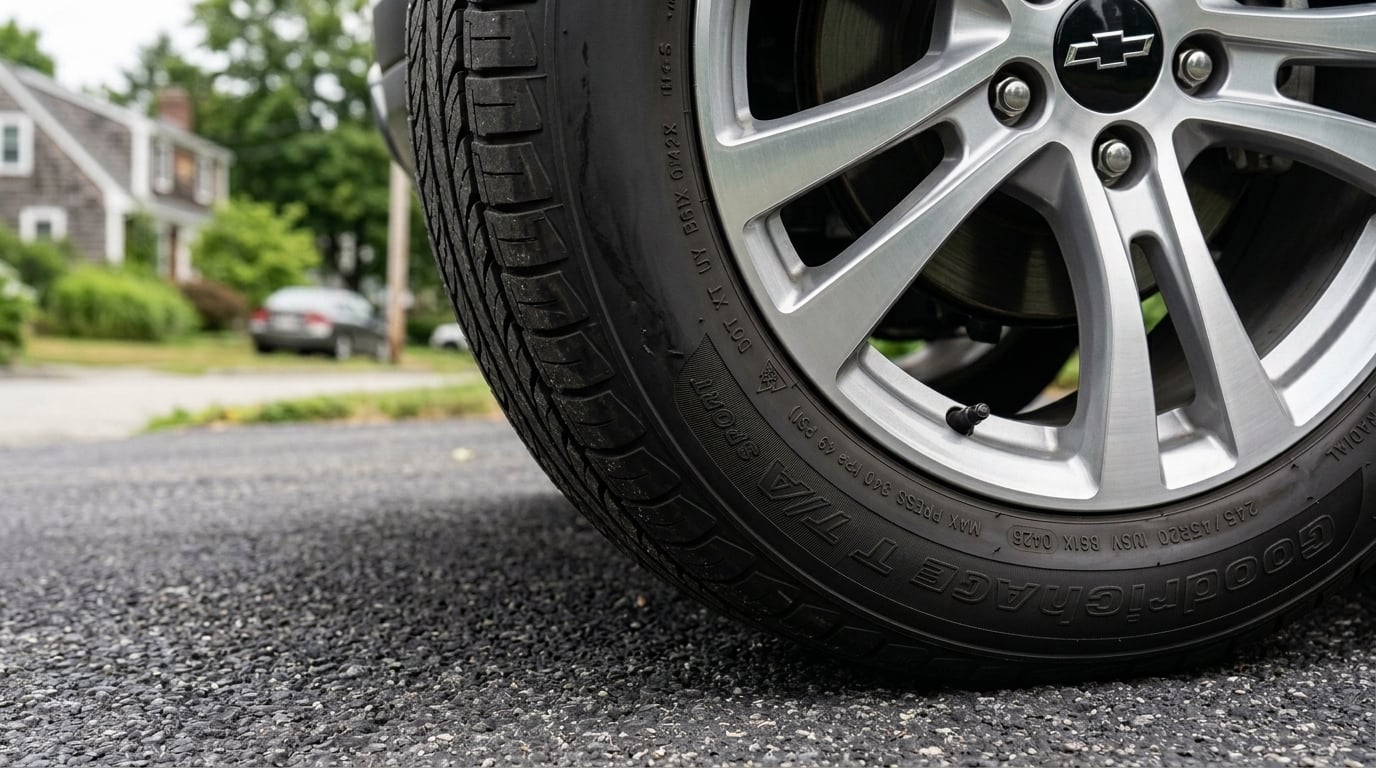
How Do You Find Factory Tire Specifications for a 2026 Chevrolet

How Do You Find Factory Tire Specifications for a 2026 Chevrolet?

You can find the exact factory tire specifications for a 2026 Chevrolet on the vehicle's Tire and Loading Information placard located on the driver side B-pillar door jamb, inside the owner's manual, and directly on the tire sidewall. The placard lists the OEM-approved tire size, recommended cold inflation pressures for front and rear tires, maximum load capacity, and spare tire inflation specs calibrated specifically for your vehicle's gross axle weight ratings. Every Chevrolet vehicle engineered for 2026 features a standardized tire code stamped on the sidewall that defines its dimensions and structural limits. Reading a size like P225/65R17 reveals distinct technical parameters: P-Metric Classification: The letter P signifies a passenger-car tire design, whereas LT denotes a light-truck build engineered for heavier payload and trailer weights. Section Width: The three-digit number specifies the tire's width in millimeters from sidewall to sidewall when mounted on an OEM rim. Aspect Ratio: The two-digit number after the slash represents the sidewall height as a percentage of the section width. Internal Construction: The letter R indicates radial construction, where internal ply cords run perpendicular to the direction of travel. Wheel Diameter: The final two-digit number defines the wheel rim diameter in inches required for correct fitment. Following the size designation, the sidewall includes the load index and speed rating—critical figures such as 95H or 102V. The load index maps to the maximum weight capacity each tire safely supports when set to the cold inflation pressure specified on the door jamb. The speed rating letter defines the maximum sustained speed the tire can handle under standardized laboratory tests. Maintaining these exact OEM ratings preserves designed handling dynamics, braking distances, and stability control calibration. When replacing tires or inspecting wear, drivers can confirm factory specifications by visiting our service center in North Dartmouth or by calling (508) 996-6266 to speak with a factory-trained technician. Table of Contents How Do Load Ratings and Pressures Change for Towing and Heavy-Duty 2026 Chevrolet Truck Configurations? What Are the Standard Tire Sizes, Bolt Patterns, and Speed Ratings for the 2026 Chevrolet Silverado 1500? How Often Should You Check Tire Pressure and When Should Winter Tires Be Installed in Eastern Massachusetts? Should You Get a Wheel Alignment When Replacing Tires on Your 2026 Chevrolet? ​ Commonly Asked Questions About 2026 Chevrolet Tire Care and Maintenance ​ Schedule Your Chevrolet Tire Care and Inspection ​ How Do Load Ratings and Pressures Change for Towing and Heavy-Duty 2026 Chevrolet Truck Configurations? Tire load ratings and cold inflation pressures must increase substantially when 2026 Chevrolet heavy-duty trucks haul maximum payloads or tow heavy trailers to prevent sidewall overheating and maintain vehicle stability. Standard passenger-rated tires carry fixed load capacities at normal street pressures, whereas heavy-duty light-truck tires utilize higher ply ratings—such as Load Range E or Load Range F —that permit higher inflation pressures to support heavy tongue weights and bed loads. On Chevrolet trucks equipped with optional heavy-duty suspension setups, off-road equipment, or the Max Trailering Package, cold tire pressure requirements differ between unloaded driving and heavy commercial service. When operating a truck under maximum load, rear tire pressures are frequently specified higher than front tire pressures—sometimes requiring up to 65 psi on rear tires compared to lower pressures for normal daily commuting. Increasing pressure under heavy loads reduces sidewall flex, which lowers internal heat buildup and improves tread contact when pulling heavy equipment along the coastal plain around Wareham. Configuration / Application Typical Tire Construction Target Rear Pressure Range Primary Service Benefit Standard Daily Driving P-Metric / Standard Load 35 psi to 38 psi Optimizes ride comfort and even tread wear Heavy Bed Payload Light Truck ( Load Range E) 50 psi to 60 psi Supports rear axle weight without sidewall deflection Maximum Gooseneck / Trailering Heavy Duty ( Load Range E / F) 60 psi to 80 psi Maintains directional stability and controls trailer sway Overloading a tire without adjusting inflation pressure compromises tread contact and strains the internal radial belting. Conversely, running maximum towing pressures on an empty truck crown-wears the center tread and harshness increases across minor road imperfections. Owners should always reference the tire pressure placard on the door jamb for specific gross vehicle weight ratings ( GVWR) and adjust pressures using an accurate pressure gauge before hitching a heavy payload. What Are the Standard Tire Sizes, Bolt Patterns, and Speed Ratings for the 2026 Chevrolet Silverado 1500? The 2026 Chevrolet Silverado 1500 utilizes several standard factory tire sizes ranging from 17-inch steel wheels on work trucks up to 22-inch aluminum wheels on high-tier trims. Engine choices, trim levels, and regional package selections dictate the factory wheel diameter and tire profile fitted at the assembly plant. Standard factory tire dimensions for the 2026 Silverado 1500 lineup include: 255/70R17 (Standard on WT base configurations) 265/70R17 (Standard on Custom and select mid-tier trims) 265/65R18 (Standard on LT, RST, and Trail Boss models) 275/60R20 (Standard on LTZ and High Country models) 275/50R22 (Optional on High Country premium packages) Across all 2026 Silverado 1500 models, the factory wheel bolt pattern measures 6x139.7mm (also referred to as 6x5.5 inches) with a hub-centric center bore measuring 78 mm. This bolt pattern ensures precise wheel alignment over the axle hub flange, distributing vehicle mass and cornering torque evenly across all six wheel studs. When switching between wheel sizes—such as moving from a 20-inch highway wheel down to an 18-inch wheel for off-road durability—maintaining the overall tire outer diameter ensures the speedometer, odometer, and transmission shift algorithms function correctly without recalibration. Factory tires for the Silverado 1500 generally carry a speed rating of S (rated for sustained speeds up to 112 mph) or T (rated up to 118 mph), paired with a load index between 112 and 116. These speed and load specs match the truck's speed-governed top velocity and electronic chassis controls like StabiliTrak. Fitting replacement tires with lower speed ratings or reduced load indices can affect braking distance and traction response during high-load maneuvers. How Often Should You Check Tire Pressure and When Should Winter Tires Be Installed in Eastern Massachusetts? Tire pressure on a 2026 Chevrolet should be checked at least once a month when the tires are cold, as ambient air temperature fluctuations directly alter inflation levels. For every 10-degree drop in outside air temperature, tire pressure drops approximately 1 psi. In addition to monthly checks, drivers should verify tire pressures before extended highway trips or whenever carrying heavy cargo. In Eastern Massachusetts, winter tire installation should occur in mid-November when ambient daily temperatures consistently drop below 45 degrees Fahrenheit. All-season rubber compounds begin to harden at sub-47-degree temperatures, reducing flexibility and wet-road grip. Specialized winter tires utilize micro-silica tread compounds that stay pliable in freezing weather, paired with dense siping patterns that grip snow and slush. Massachusetts law permits the use of studded winter tires on public roadways only from November 1 through April 30. Vehicle owners driving rural routes near Rochester rely on dedicated winter tread to clear mud, snow, and ice from unpaved agricultural roads during early spring thaws. Winter tires should be removed and stored around early April when ambient daily temperatures climb reliably back above 45 degrees, preventing premature tread wear on warm pavement. Checking pressure must always be done while the vehicle has been parked for at least three hours or driven less than one mile. Always inflate to the cold tire pressure specification listed on the driver's door B-pillar rather than the maximum pressure stamped on the tire sidewall, which reflects only the tire's structural burst limit. ​ Should You Get a Wheel Alignment When Replacing Tires on Your 2026 Chevrolet? Getting a four-wheel alignment when installing new tires on your 2026 Chevrolet is highly recommended to protect your tire investment and ensure predictable vehicle handling. Even slight camber, caster, or toe misalignments caused by pothole impacts or worn suspension bushings will cause rapid, uneven tread wear on fresh tires within a few thousand miles. Key indicators that signal the need for an immediate wheel alignment include: Uneven or feathered wear across the inner or outer tread shoulder of old tires. The steering wheel sitting off-center when driving straight on a flat road. The vehicle pulling or drifting toward one side of the lane when steering wheel pressure is relaxed. Unusual vibration or steering column feedback at highway speeds. A precise wheel alignment sets all four tires parallel to each other and perpendicular to the road surface, matching Chevrolet factory chassis tolerances. Aligning the suspension during tire installation ensures that advanced safety systems—such as Lane Keep Assist and electronic stability control—receive accurate steering angle sensor data. Skipping an alignment during a tire replacement risks premature tire cupping, reduced fuel economy, and shortened tire lifespan. ​ Commonly Asked Questions About 2026 Chevrolet Tire Care and Maintenance Q: Where is the tire pressure monitoring system resetting button located on my 2026 Chevrolet? Most 2026 Chevrolet models monitor tire pressures automatically using internal rim sensors that update the driver information center as you drive. If a low-pressure warning remains illuminated after inflating tires to the door-jamb specification, driving the vehicle above 20 mph for several minutes typically recalibrates the Tire Pressure Monitor System. On select models, sensor learning modes can be accessed directly through the infotainment vehicle status menu or steering wheel controls. Q: How do I read the age of a tire using the DOT code on the sidewall? The manufacturing date of any Chevrolet tire is stamped within the DOT serial code located near the wheel rim edge on the sidewall. Look for a four-digit number at the end of the code string. The first two digits represent the week of production (from 01 to 52), while the last two digits represent the year. For example, a code ending in 1225 indicates the tire was manufactured during the 12th week of 2025. Q: Can I downsize my 20-inch wheels to 18-inch wheels for winter driving on a Silverado? Yes, downsizing from 20-inch factory wheels to 18-inch wheels is a common practice for winter driving on a 2026 Chevrolet Silverado. The smaller wheel diameter allows for a taller tire sidewall, which provides improved cushion against pothole impacts and superior snow traction. When downsizing, ensure the replacement 18-inch wheel clears the front brake calipers and maintains the factory 6x139.7mm bolt pattern and overall tire outer diameter. Q: How often should tires be rotated on a 2026 Chevrolet SUV or truck? Tires should be rotated every 7,500 miles or during every engine oil service, whichever comes first. Regular rotation redistributes front-to-rear tread wear evenly, particularly on front-wheel-drive crossovers where front tires handle steering, braking, and drive torque simultaneously. Following the recommended cross-switch or front-to-back rotation pattern maximizes tread life and maintains balanced wet-weather traction. Q: What is the difference between all-season and all-weather tires for New England driving? All-season tires are designed to handle dry roads, wet spring pavement, and mild summer temperatures, but their rubber compound hardens below freezing. All-weather tires feature advanced silica rubber compounds and aggressive tread patterns certified with the Three-Peak Mountain Snowflake (3PMSF) symbol. This rating indicates they meet designated severe snow performance standards while remaining suitable for year-round driving without seasonal changeouts. Maintaining your vehicle's tire health keeps your safety systems functioning properly and preserves optimal handling performance. Drivers can easily request complete tire rotations, wheel balances, and tire inspections by scheduling a certified service appointment online with our maintenance department. Schedule Your Chevrolet Tire Care and Inspection Proper tire selection, correct inflation pressures, and routine maintenance are essential for maximizing safety, fuel efficiency, and performance in your 2026 Chevrolet. Whether you need an official tread depth evaluation, a precision wheel alignment, or seasonal winter tire changeouts, our factory-trained technicians provide complete support using genuine OEM specifications and specialized diagnostic equipment. Our state-of-the-art service department maintains a comprehensive inventory of factory-approved tires designed specifically for Chevrolet cars, crossovers, and heavy-duty trucks. We inspect sidewall integrity, check DOT date codes, verify load index ratings, and program tire pressure monitoring sensors to keep your vehicle performing exactly as engineered. Take action today to protect your vehicle investment and maintain optimal stopping power on regional roads. Get complete tire service by visiting our North Dartmouth location or give our service team a call at (508) 996-6266 to speak directly with a service coordinator. © 2026 Colonial South Chevrolet. All rights reserved.