





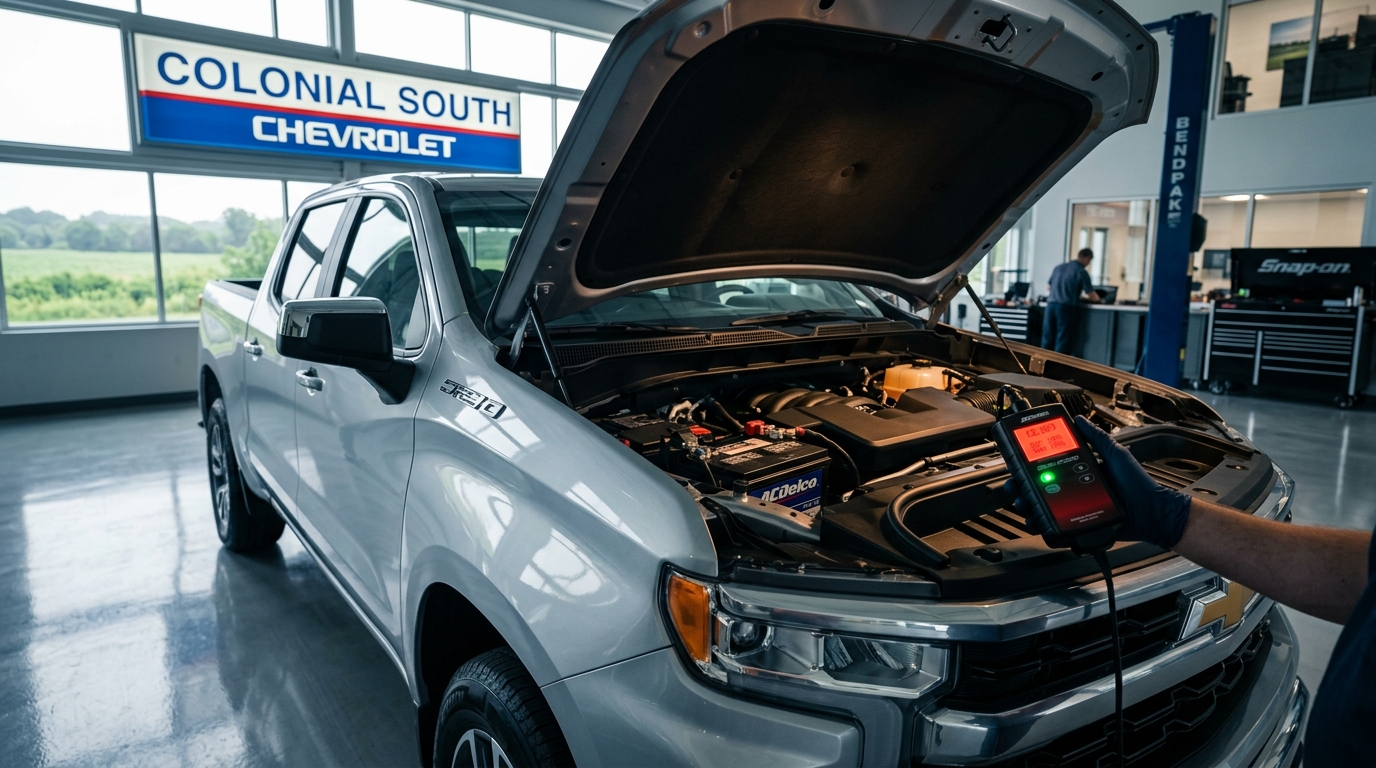
Maintaining the 12-Volt Foundation of Your 2026 Chevrolet
The 12-volt battery remains the heartbeat of every 2026 Chevrolet, serving as the essential power source for everything from the starter motor in a 2026 Chevrolet Silverado 1500 to the complex sensor arrays in electric models. While high-voltage propulsion batteries often get the most attention, the low-voltage 12-volt system is responsible for waking up the vehicle’s computers, engaging safety systems, and powering interior accessories. Without a healthy 12-volt charge, even a fully charged electric vehicle cannot engage its high-voltage contactors to drive.
Our technicians often see how the agricultural demands in Rochester can put unique stress on these systems. When a truck is used for frequent short trips across farmland or left idling with high-draw accessories like strobe lights or winches, the 12-volt battery may not have sufficient time to reach a full state of charge. To ensure your vehicle remains reliable, we recommend a professional inspection of the battery terminals for tightness and the absence of acid-based corrosion. If you have questions about your specific model’s requirements, you can reach our service team at (508) 996-6266 for expert guidance.
Proper care involves more than just checking for a charge; it requires understanding how your specific Chevrolet manages its power. For instance, the 2026 Chevy Silverado 1500 features a basic 3 years / 36,000 miles warranty that covers the original battery against manufacturing defects. Beyond the warranty period, maintaining the battery’s health is a proactive way to avoid being stranded. If you are noticing a slow engine crank or flickering interior lights, visiting our North Dartmouth service center for a load test can provide a definitive look at the battery’s remaining capacity.
Table of Contents
- Understanding Battery Longevity and Environmental Stressors in Massachusetts
- Advanced Health Monitoring and Built-in Diagnostic Systems
- The Critical Role of the 12V Battery in Propulsion and Sensor Accuracy
- Technical Best Practices for Safe Battery Replacement and Cable Management
- Common Technical Questions Regarding Chevrolet Battery Performance
- Professional Battery Testing and Maintenance at Colonial South Chevrolet
Understanding Battery Longevity and Environmental Stressors in Massachusetts
How long should you expect your battery to last? While the industry average for a lead-acid or AGM battery is roughly six years, the reality in New England is often closer to three or four years. This discrepancy is largely due to the “cold-winter” climate zone we inhabit. Prolonged sub-freezing temperatures significantly slow down the chemical reactions inside the battery, reducing its ability to provide the necessary amperage to start a V8 engine like the one found in the 2026 Chevrolet Tahoe.
In coastal areas like Wareham, the combination of humidity and road salt creates a highly corrosive environment for electrical components. Salt air can accelerate the buildup of “white fuzz” or lead-sulfate crystals on battery terminals, which increases electrical resistance and forces the charging system to work harder. To combat these local challenges, we suggest:
- Keeping battery terminals clean and protected with a thin layer of anti-corrosion grease.
- Utilizing a smart maintainer if the vehicle is stored for the winter.
- Checking the battery’s “State of Health” during every oil change or multi-point inspection.
For those looking to stay ahead of seasonal maintenance, checking our current service and parts specials can provide cost-effective opportunities for battery testing and replacement. Whether you are driving a gas-powered 2026 Chevrolet Equinox or a Silverado EV, the 12-volt battery is susceptible to the same environmental degradation. Extreme heat in the summer is actually more damaging to the internal plates than the cold, but it is the winter’s high-torque starting demands that usually reveal the damage done during the warmer months.
Advanced Health Monitoring and Built-in Diagnostic Systems
Modern Chevrolet engineering has moved far beyond simple “idiot lights” on the dashboard. The 2026 lineup features sophisticated Battery Management Systems (BMS) that constantly monitor the “State of Charge” (SOC) and “State of Health” (SOH). These systems track voltage, current flow, and internal temperature to calculate how much life is left in the cells. In many cases, the vehicle can detect a failing cell weeks before it actually fails to start the engine, providing a warning message on the Driver Information Center.
For electric vehicles and hybrids, this monitoring is even more critical. GM’s “Battery Maintenance Mode” or “Enhanced Battery Support Mode” allows the high-voltage battery to automatically top off the 12-volt battery at specific intervals, even when the vehicle is parked. This prevents the low-voltage system from draining due to “parasitic loads”—the small amounts of electricity used by the security system, OnStar, and remote-start receivers. If the system detects that the 12-volt battery cannot hold a charge effectively, it may disable certain non-essential features to preserve enough energy for a safe startup.
When we perform a diagnostic check, our technicians use specialized digital testers that communicate with these on-board modules. These tools can identify if a battery is simply discharged or if it has an internal “short” that requires a full replacement. This level of precision ensures that we aren’t just replacing parts, but actually resolving the root cause of an electrical issue, such as a faulty alternator or a software glitch that is keeping the vehicle’s computers “awake” longer than they should be.
The Critical Role of the 12V Battery in Propulsion and Sensor Accuracy
Does a failing 12-volt battery trigger “Reduced Propulsion Power” messages? The answer is a definitive yes. Because the 12-volt system powers the sensors, control modules, and communication networks that manage the high-voltage drivetrain, any voltage instability can cause these sensors to report “ghost” errors. If the propulsion control module receives a signal that is outside of its expected voltage range, it may put the vehicle into a “limp mode” or display a propulsion error to protect the high-voltage components.
This is particularly relevant for heavy-duty applications. A 2026 Chevrolet Silverado 1500 equipped with the Special Service Package or advanced trailering tech relies on the 12-volt system to power up to 14 different camera views and the In-Vehicle Trailering App. If the battery voltage drops, these high-tech features may glitch or fail to initialize. Maintaining a stable 12-volt foundation ensures that safety features like Lane Keep Assist and Forward Collision Alert function with the precision intended by Chevrolet engineers.
Furthermore, the 12-volt battery acts as a “buffer” for the vehicle’s electrical system, smoothing out voltage spikes from the alternator or DC-to-DC converter. A weak battery loses this buffering capability, which can lead to premature wear on sensitive electronic control units (ECUs). By replacing a weak 12-volt battery before it fails completely, you are essentially protecting the much more expensive computers that run your vehicle’s engine, transmission, and safety suites.
Technical Best Practices for Safe Battery Replacement and Cable Management
When it comes time for a replacement, the order of operations is vital for both safety and the longevity of the vehicle’s electronics. Chevrolet service manuals specify that you should always disconnect the negative (black) cable first. This is because the entire metal frame of the vehicle is connected to the negative terminal. If you were to loosen the positive terminal first and your wrench accidentally touched a metal part of the engine bay, it would create a massive electrical short, potentially causing sparks, burns, or damage to the vehicle’s wiring harness.
For 2026 models, the replacement process often involves more than just a physical swap. Many new Chevrolet vehicles require a “Battery Sensor Reset” or “BMS Relearn” procedure. This tells the vehicle’s computer that a fresh battery has been installed so it can adjust the charging rate accordingly. An old battery requires a higher charging voltage; if the computer doesn’t know the battery is new, it may overcharge it, significantly shortening the life of the new replacement.
Our service team also emphasizes the importance of using the correct battery type. While older vehicles used standard flooded lead-acid batteries, many 2026 models, especially those with Auto Start-Stop technology or electric drivetrains, require Absorbent Glass Mat (AGM) batteries. These are designed to handle more frequent deep cycles and offer higher Cold Cranking Amps—often rated at 800 CCA for trucks—to ensure reliable performance in harsh New England winters. Using a standard battery in a vehicle designed for an AGM can lead to rapid battery failure and charging system errors.
Common Technical Questions Regarding Chevrolet Battery Performance
Q: Does the 2026 Chevrolet have a built-in battery tester? The vehicle features a sophisticated on-board diagnostic system that monitors the battery’s State of Health (SOH). While it doesn’t show a real-time “percentage” like a smartphone, it will trigger a “Service Battery” or “Battery Low” warning on the dashboard if the capacity falls below a threshold that ensures a reliable start.
Q: Can I use a regular 12-volt maintainer on a Chevrolet EV? Yes, a standard smart maintainer compatible with AGM batteries can generally be used. However, it is important to use the designated jump-start or charging points under the hood rather than connecting directly to the battery terminals if the battery is tucked away, as this ensures the current flows through the vehicle’s monitoring sensors.
Q: Why is my battery dying faster even though I don’t drive much? Modern vehicles have “parasitic draws” from security systems and remote connectivity. In a rural setting like Rochester, if a vehicle sits for weeks without being driven, these small draws can deplete the 12-volt battery. We recommend driving the vehicle for at least 20 minutes once a week to allow the charging system to top off the battery.
Q: Is the 12-volt battery covered under the Powertrain Warranty? No, the 12-volt battery is typically considered a wear-and-tear item covered under the basic 3 years / 36,000 miles bumper-to-bumper warranty. The 5 years / 60,000 miles powertrain warranty covers the engine, transmission, and drive systems, but not the accessory battery.
Q: What happens if I disconnect the battery and lose software sync? In some cases, losing 12-volt power for an extended period can cause “volatile memory” to clear, which might require resetting your clock, radio presets, or even window indexing. For EVs, it can sometimes cause a temporary delay in the high-voltage system’s readiness as the modules re-sync.
Professional Battery Testing and Maintenance at Colonial South Chevrolet
Whether you are preparing for a long winter or noticing strange electrical behavior in your vehicle, our certified technicians are here to help. We use factory-grade diagnostic equipment to provide an accurate picture of your battery’s health, ensuring you aren’t caught off guard by a sudden failure. If a replacement is necessary, we stock genuine OEM batteries designed specifically for your model’s electrical load and mounting requirements. To ensure your vehicle is ready for the road, you can schedule a service appointment online or give us a quick call. For those nearby, our North Dartmouth location is conveniently situated to serve all your maintenance needs.
© 2026 Colonial South Chevrolet. All rights reserved.
Connect with us

